Pasta with sardines, pine nuts, and raisins
(Scroll down for the English translation)
Cosa vi serve
Per due persone, se avete i bigoli quelli veri, non serve che vi dico nulla, altrimenti vanno bene 250 grammi di bucatini o di spaghetti grossi, cipolla bianca, aglio, vino bianco, sardine o acciughe, uva passa, pinoli, pan grattato.
Introduzione
Nel posto dove vivo c’è un’usanza, che il mercoledì delle ceneri si mangia l’aringa e i bigoli in salsa, che sono – per chi non è della zona – degli spaghettoni fatti in casa con una salsa di cipolla olio e acciughe. E sono molto affezionato a questa usanza perché io non sono di qua, e quando ho iniziato a vivere in questo posto, nel lontanissimo 2002, era febbraio, mi ero trasferito per lavoro, non conoscevo nessuno ero completamente da solo e la prima cosa bella che mi è capitata è che il fotografo per cui lavoravo ci ha portati a pranzo fuori, io e gli altri dello studio in cui lavoravo, nel giorno della renga.
Però c’è un fatto, che i miei genitori sono siciliani e, evidentemente, lo erano anche i miei nonni, e uno dei sapori più buoni che ho tra i miei ricordi gustativi d’infanzia è la pasta con le sarde che facevano le mie nonne. E che rifarei volentieri ogni volta che mi viene voglia ma non è possibile perché uno degli ingredienti fondamentali della pasta con le sarde è il finocchietto. Non il finocchio, ma proprio il finocchietto che è un’erba selvatica che in Sicilia la trovi dappertutto, qua invece è introvabile. Quindi niente pasta con le sarde. Nella pasta con le sarde non ci va solo il finocchietto, ci vanno anche altre cose, tipo i pinoli e l’uva passa. E ogni volta che mi capita di mangiare i bigoli in salsa il mio cervello, la mia lingua, il palato mi dicono Buoni buoni buonissimi, datemene ancora, ma perchè in questa pasta che sa di cipolla, che sa di sarde, non sento anche il sapore dell’uvetta e dei pinoli?
e allora, è andata così, che ho unito le due paste più buone che ho nella testa e ne ho fatta una sola.
preparazione
Anche questa volta poche foto, scusate, voi fate quello che dico io e tutto andrà bene.
Mettete l’uvetta a bagno nell’acqua fredda. Prendete una cipolla bianca grande, ce ne vuole tanta non siate taccagni, e tagliatela più fine che potete. E tritate anche uno spicchio d’aglio. Se avete un mixer tritate con quello. Mettete cipolla e aglio in padella con abbondante olio e fate cuocere a fuoco lento per molto tempo, deve quasi sciogliersi. Io ci metto anche un pochino del mio olio piccante. Poi aggiungete le sarde, sardine, acciughe, quello che avete, basta che anche qui non siate tirchi. Dovete farle cuocere sempre a fuoco basso fino a far sciogliere il pescetto insieme alla cipolla. Sfiammate col vino bianco, e poi aggiungete un pochino di acqua un po’ alla volta per non far asciugare il sugo.
E fin qui, questa roba sarebbe la salsa dei bigoli in salsa. Più o meno. Non so se la tradizione locale vuole esattamente questa procedura, ricordatevi che son forestiero, ma secondo me questa è.
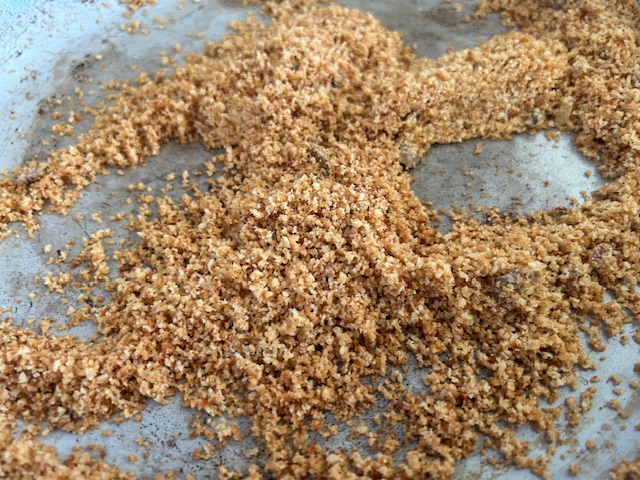
Adesso arriva il colpo di genio. In una padella a parte mettete dell’olio, uno o due filetti di acciuga (o di sardina) e fateli sciogliere nell’olio a fuoco basso. Aggiungete abbondante pan grattato e sempre col fuoco acceso fate sì che il pane assorba l’olio aromatizzato all’acciuga e si abbrustolisca, muovetelo continuamente con una paletta. Il pane deve dorarsi ma non bruciare, c’è la foto guardatela. Quando è pronto spegnete e mettete da parte.
Nel frattempo ovviamente avrete messo su anche l’acqua per la pasta.
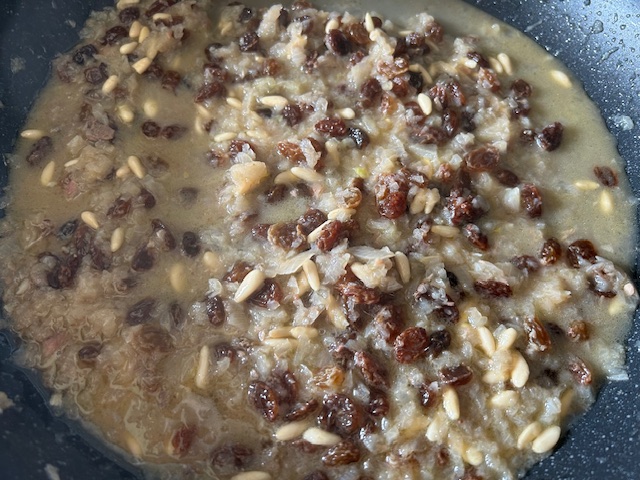
Torniamo alla nostra salsa di cipolla e sarde, dobbiamo semplicemente aggiungere l’uvetta che prima abbiamo ammorbidito nell’acqua e i pinoli. Fate cuocere per un pochino aggiungendo anche dell’acqua di cottura in modo tale che la salsa resti bella cremosa.
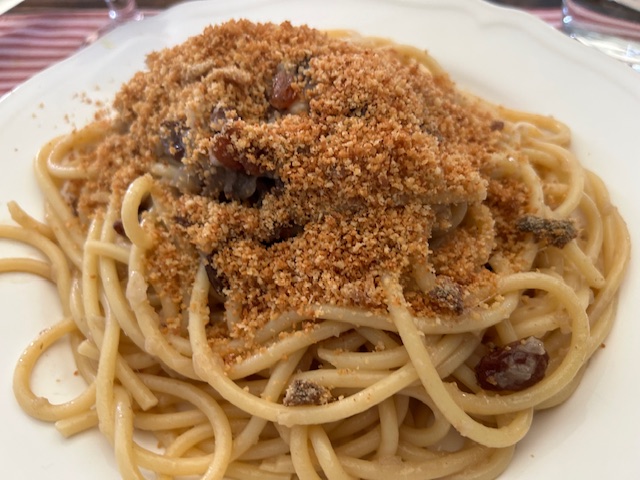
Scolate la pasta, mettetela in padella e fatela saltare, poi impiattate e spolverate abbondantemente col pan grattato abbrustolito.
Non sono più bigoli in salsa, è una parente molto lontana della pasta con le sarde, ed è buona da matti.
What you need
For two people, if you have italian origins and you have real bigoli, I don’t need to tell you anything, otherwise, 250 grams of bucatini or thick spaghetti will do just fine. White onion, garlic, white wine, sardines or anchovies, raisins, pine nuts, breadcrumbs.
Introduction
In the place where I live, there’s a tradition: on Ash Wednesday, we eat herring and bigoli in salsa. For those not from around here, Bigoli are homemade thick spaghetti with onion, oil, and anchovy sauce. I’m very fond of this tradition because I’m not originally from here, and when I first moved to this place way back in february 2002 for work, I didn’t know anyone. I was completely alone, and the first nice thing that happened to me was that the photographer I worked for took me and the rest of the studio out for lunch on the “day of the renga” (herring).
But here’s the thing: my parents are sicilian and, obviously, so were my grandparents. One of the best flavors in my childhood food memories is the “pasta con le sarde” my grandmothers used to make. I’d love to recreate it whenever the craving hits, but it’s impossible because one of the key ingredients is finocchietto (wild fennel). Not regular fennel, but specifically wild fennel—a wild herb you find everywhere in Sicily, but in this area, it’s impossible to be found. So, no pasta con le sarde here. But it’s not just the wild fennel, other things go in it too, like pine nuts and raisins. And every time I eat bigoli in salsa, my brain, my tongue, and my palate tell me, “Good, good, delicious, give me more! But why, in this pasta that tastes of onion and sardines, don’t I also taste the raisins and pine nuts?”
And so, that’s how it happened—I merged the two best pasta dishes I’ve got in my head and made them into one.
Preparation
Not many photos this time either, sorry, just do as I say and everything will be fine.
Soak the raisins in cold water. Take a large white onion—you need a lot, don’t be stingy—and slice it as thin as you can. Mince a clove of garlic too. If you have a food processor, use that. Put the onion and garlic in a pan with plenty of oil and cook over low heat for a long time, it should almost melt. I also add a little bit of my spicy chili oil. Then add the sardines, anchovies, whatever you have—just don’t be cheap here either. You need to cook them over low heat until the fish melts into the onion. Deglaze with white wine, and then add a little water bit by bit so the sauce doesn’t dry out.
Up to this point, this stuff is basically the sauce for bigoli in salsa. More or less. I don’t know if the local tradition wants this exact procedure—remember, I’m a foreigner—but in my opinion, this is it.
Now comes the genius. In a separate pan, put some oil and one or two anchovy (or sardine) fillets and let them melt over low heat. Add plenty of breadcrumbs and, keeping the heat on, let the bread absorb the anchovy-flavored oil and toast, turn it continuously. The bread should turn golden brown but not burn—look at the photo. When it’s ready, turn off the heat and set it aside.
In the meantime, of course, you’ll have put the water on for the pasta.
Back to our onion and sardine sauce: simply add the raisins (softened in water) and the pine nuts. Cook for a little while, adding some pasta cooking water so the sauce stays creamy.
Drain the pasta, toss it in the pan, then plate it and dust it generously with the toasted breadcrumbs.
It’s no longer bigoli in salsa, it’s a very distant relative of pasta con le sarde, and it’s crazy good.
 Villa della Comare